The Aussie dollar is having a moment—but can it last?
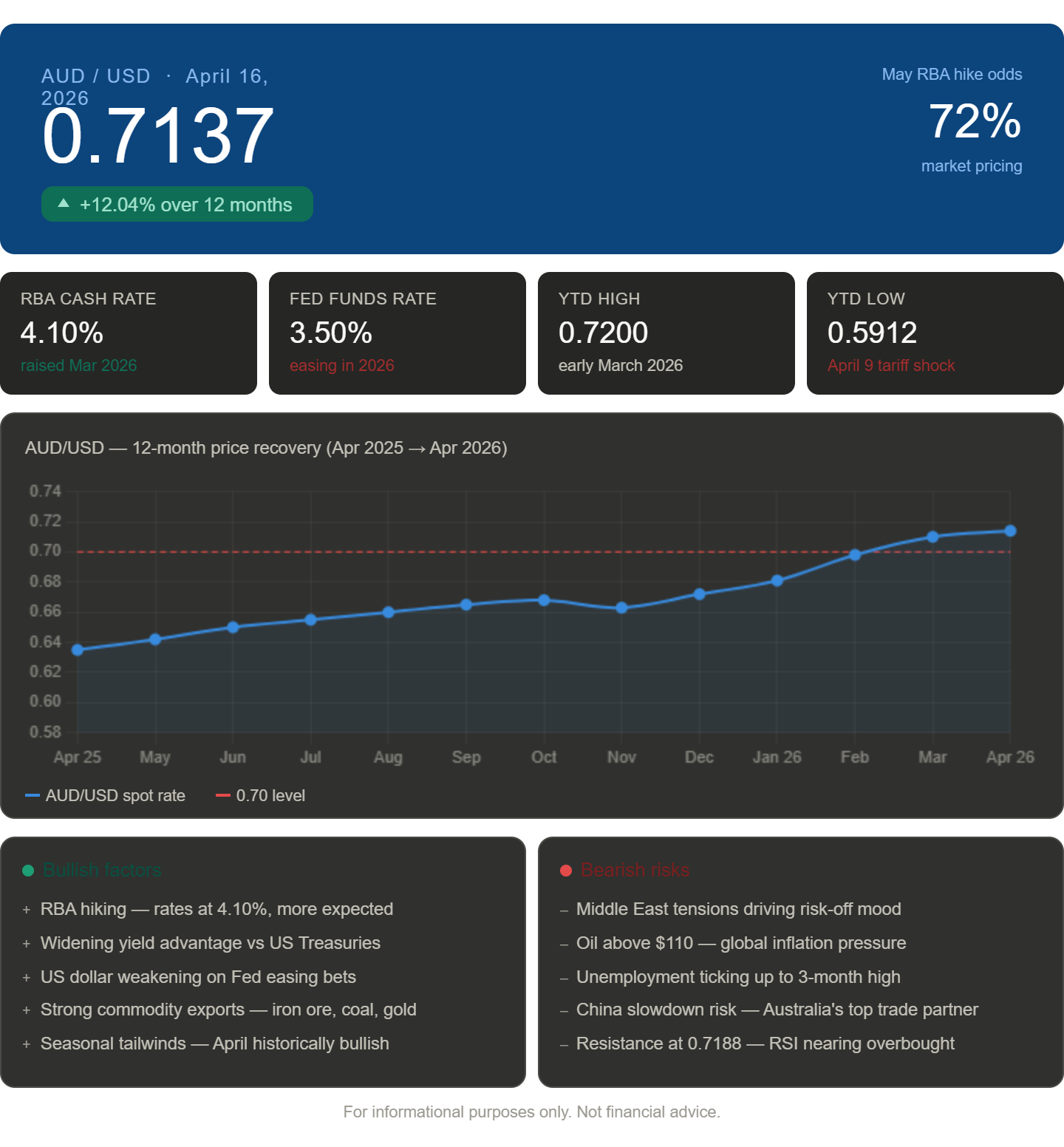
There's a quiet confidence building around the Australian dollar right now. After a bruising few years of sitting in the shadows, AUD/USD has climbed back above 0.71—reaching 0.7137 on April 15, 2026, up over 12% in the past twelve months alone. TRADING ECONOMICS For anyone who's been watching the pair, that's not a small move. It's a signal that something has genuinely shifted.
So what's driving it? And more importantly, is this the beginning of a sustained rally or just a well-timed bounce?
The RBA Is Playing Hardball
The biggest story behind the Aussie's strength isn't commodity prices or China optimism—though both play a role. It's the Reserve Bank of Australia and the fact that it has become one of the most hawkish central banks in the developed world.
The RBA raised its cash rate to 4.10% in March 2026, and markets aren't expecting it to stop there. Westpac forecasts three more hikes — in May, June, and August — that would push rates to 4.85%, the highest level since November 2008. RoboForex
That's a significant policy stance. While other central banks have been cautiously cutting or pausing, the RBA is still tightening. And when a country's rates are rising relative to its peers, its currency tends to follow.
RBA Deputy Governor Andrew Hauser recently stressed that inflation remains above the 2–3% target and that policymakers aren't yet confident current rates are sufficiently restrictive—leaving the door firmly open to further increases. TRADING ECONOMICS Markets took note: the probability of a May rate hike was nudged up to 72% following his remarks.
The Dollar's Softening—and That Helps
On the other side of the trade, the US dollar is losing some of its structural advantage. The Fed is expected to cut rates by another 50 basis points by the end of 2026, bringing the funds rate down to the 3.00–3.25% range—while the RBA's cash rate is projected to end the year just above 4%. IG
That widening interest rate differential is a tailwind for the Aussie. When investors can earn meaningfully more holding Australian dollar assets than US dollar ones, capital flows tend to shift accordingly. Australian bond yields have already broken their multi-year sideways trend relative to US Treasuries, now clearly outperforming them—a dynamic that's attracting flows into AUD. XS
The Geopolitical Wild Card
Nothing in forex is ever clean, and AUD/USD has its share of risk. The Middle East situation is proving to be a double-edged sword.
When hopes of a US-Iran peace deal gained traction, the Aussie hit a five-week high of $0.71. But when those same talks collapsed and the US announced a blockade on Iranian oil shipments, the pair tumbled back below $0.703 as risk aversion swept through global markets. TRADING ECONOMICS
This pattern is worth understanding. The Australian dollar is what traders call a "risk-sensitive" currency—when global sentiment sours, the Aussie tends to get sold. Oil prices above $110 per barrel are also feeding into inflation fears that could eventually slow consumer spending and put pressure on the RBA to ease off.
The Technical Picture
AUD/USD is currently trading at 0.7167, sitting comfortably above its 55-, 100-, and 200-day moving averages. The pair is pressing into key resistance around 0.7188—a Fibonacci swing high—and the RSI at 65 points to firm positive momentum, though it's nudging toward overbought territory. FXStreet
A daily close above 0.7188 would open the door toward 0.7283 and potentially 0.7661. On the downside, support sits near the 55-day moving average around 0.7033, with deeper cushioning at 0.6895 and 0.6880. FXStreet
For traders watching the chart, the setup is constructive — but that resistance zone deserves respect. The pair has bumped up against this level before without breaking cleanly through.
What Comes Next
Seasonality favors the bulls from here. April and June have historically been the strongest months for AUD/USD, each posting win rates above 60% with positive average and median returns. Forex
In the near term, all eyes are on Australia's Q1 inflation print and labor market data—both due before the RBA's May decision. A hot CPI or a resilient jobs number would likely cement another hike and give the Aussie another leg up. A surprise to the downside, on the other hand, could trigger a round of long liquidation.
Longer-term, analysts project AUD/USD could reach around $0.7375 by the end of 2026 (Traders Union), though that would require a continued combination of RBA hawkishness, US dollar softness, and steady risk appetite globally.
The bottom line: The Australian dollar's rally is built on real foundations — a hawkish central bank, a softening US dollar, and improving rate differentials. But it's not without fragility. Geopolitical shocks, a surprise in the US jobs market, or a stumble in China could unwind gains quickly. Watch the 0.7188 resistance level closely. How the pair behaves there will say a lot about whether this rally has real legs—or whether the market is getting a little ahead of itself.
Disclaimer: This article is for informational purposes only and does not constitute financial or investment advice. Always consult a qualified financial advisor before making trading decisions.